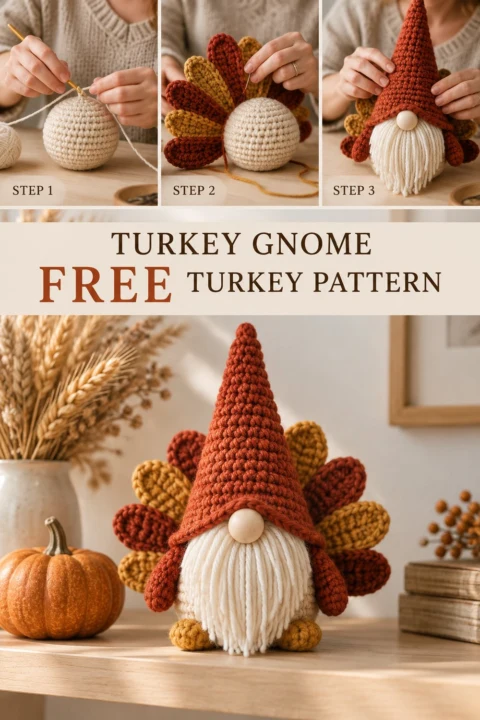
Plump Turkey Gnome Crochet Shelf Sitter Free Thanksgiving Pattern
Reader Favorites


Corner To Corner Crochet Tutorial For Beginners Free Crochet Pattern

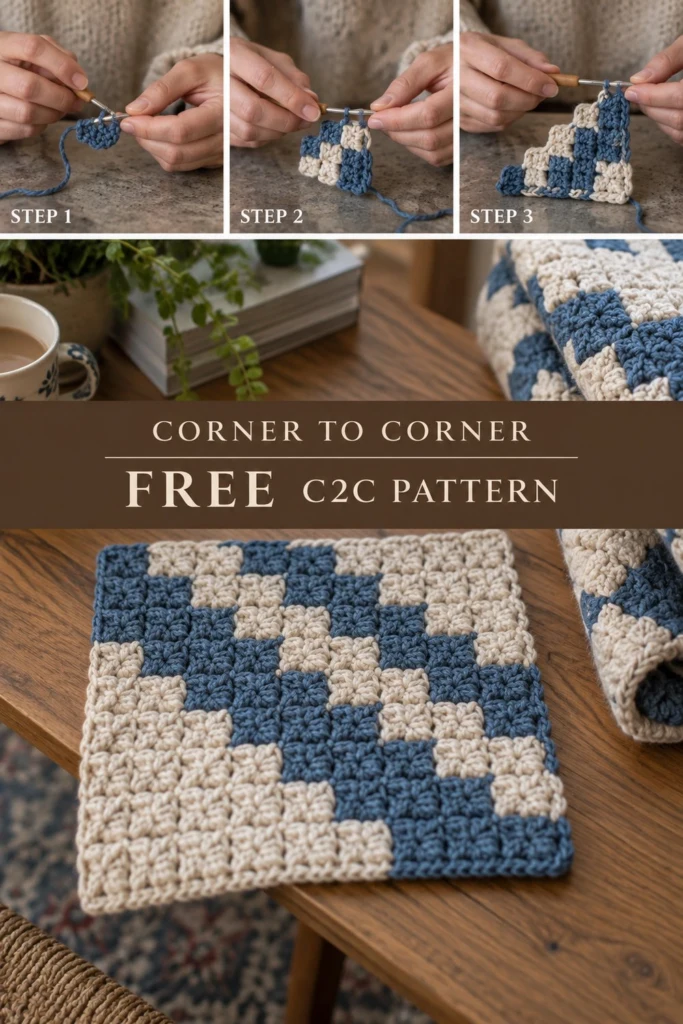
Corner-to-corner (C2C) crochet is one of the most versatile techniques in yarn craft, allowing you to create stunning geometric patterns, pixelated pictures, and textured blankets working diagonally from one corner to the opposite edge. This step-by-step tutorial breaks down the classic double crochet C2C block stitch using a manageable 10×10 block swatch in rich denim blue and warm cream. Follow along to master C2C increases, color changes, and clean corner decreases before tackling your next big graphghan project.
Corner To Corner Crochet Tutorial For Beginners Free Crochet Pattern
Quick Facts
- Skill level: Easy / Upper Beginner
- Finished size: 8 x 8 in (20 x 20 cm)
- Yarn: Medium weight (Category 4) acrylic or cotton yarn in Denim Blue and Cream
- Hook: 5.0 mm (US H-8)
- Stitches used: Chain (ch), Slip Stitch (sl st), Double Crochet (dc)
- Time to make: 1.5 to 2 hours
Size customization tips are included further down in this guide.
What Makes This C2C Swatch Special
C2C crochet builds texture by tilting small blocks composed of three double crochets worked into turning chain spaces. Instead of working back and forth in standard horizontal rows, each row builds diagonally, adding one new block per row during the increase phase until you reach your maximum width, then subtracting one block per row during the decrease phase.
In this swatch, you will learn four essential C2C skills visible in the step-by-step photos:
1. The Starting Block & Increase Turn (Step 1): Creating the foundational block with a chain-6 setup.
2. Seamless Color Joining (Step 2): Changing yarn colors at the final pull-through of a slip stitch or double crochet to create clean geometric color transitions.
3. The Corner Decrease Turn (Step 3): Transitioning from growing your square to leveling off the edges into a straight square corner.
4. Graphwork Patterning (Finished Sample): Reading a two-color C2C grid to construct classic checkerboard diagonals.
This stitch is ideal for three primary project types:
– Graphghan Blankets & Throw Pillows: Pixel-art designs where each C2C block represents one pixel on a chart.
– Kitchen & Bath Linens: Textured washcloths, dishcloths, and trivets that stay thick and absorbent.
– Diagonal Striped Accessories: Scarves, cowls, and shawls featuring bold diagonal striping without complex shaping.
Skill Level
This project is suitable for an confident beginner comfortable with basic stitches.
- Working basic chains, slip stitches, and double crochets.
- Identification of chain-3 spaces.
- Changing colors at the end of a stitch.
- Counting diagonal block rows.
Don’t worry if your first few blocks feel slightly loose—C2C relaxes naturally into a uniform grid once blocked!
Finished Measurements
| Measurement | Inches | Metric (cm) |
|---|---|---|
| Width | 8.0 in | 20.0 cm |
| Height | 8.0 in | 20.0 cm |
| Block Dimensions (1 block) | 0.8 x 0.8 in | 2.0 x 2.0 cm |
Materials You Will Need
| Material / Item | Specification | Quantity Required |
|---|---|---|
| Main Color (MC) | Denim Blue (Category 4 Medium / Worsted) | 45 yds (41 m) / 25 g |
| Contrast Color (CC) | Cream (Category 4 Medium / Worsted) | 45 yds (41 m) / 25 g |
| Crochet Hook | 5.0 mm (US H-8) ergonomic inline hook | 1 hook |
| Tapestry Needle | Large-eye blunt tip yarn needle | 1 needle |
| Scissors | Craft or embroidery scissors | 1 pair |
| Stitch Markers | Locking plastic markers | 2 markers (optional) |
Yarn Suggestions
| Yarn Brand & Line | Weight / Fiber | Yardage per Skein | Notes |
|---|---|---|---|
| Lion Brand 24/7 Cotton | Category 4 / 100% Mercerized Cotton | 186 yds (170 m) / 100 g | Excellent stitch definition, crisp square corners, minimal pilling. |
| Caron Simply Soft | Category 4 / 100% Acrylic | 315 yds (288 m) / 170 g | Soft drape, gentle sheen, comfortable for blankets and swatches. |
| Red Heart Super Saver | Category 4 / 100% Acrylic | 364 yds (333 m) / 198 g | Durable, budget-friendly option with wide color range for graphghans. |
⚠️ Note: Avoid novelty yarns with long fur, heavy chenille texture, or loose roving plies for C2C projects. These textures obscure the chain-3 spaces, making it difficult to locate where to insert your hook for subsequent blocks.
Gauge
| Measure | Count | Stitch / Row Type |
|---|---|---|
| 4 x 4 in (10 x 10 cm) | 5 C2C blocks | Double Crochet C2C Block Stitch |
| 4 x 4 in (10 x 10 cm) | 5 diagonal rows | Double Crochet C2C Block Stitch |
Abbreviations
| Abbreviation | Full Name (US Terminology) |
|---|---|
| ch | Chain |
| dc | Double Crochet |
| sl st | Slip Stitch |
| sp | Space |
| st(s) | Stitch(es) |
| MC | Main Color (Denim Blue) |
| CC | Contrast Color (Cream) |
UK Translation: UK Double Crochet (dc) = US Single Crochet (sc); UK Treble Crochet (tr) = US Double Crochet (dc); UK Half Treble (htr) = US Half Double Crochet (hdc).
Special Stitches Explained
1. C2C Increase Block (First Block of an Increasing Row)
- Chain 6.
- Double crochet into the 4th chain from your hook.
- Double crochet into each of the remaining 2 chains. (You now have a block made of 1 turning ch-3 space and 3 dc stitches).
2. C2C Standard Block (Middle / Body Block)
- Slip stitch into the ch-3 space of the corresponding block from the previous row.
- Chain 3.
- Work 3 double crochet stitches into that same ch-3 space.
3. C2C Decrease Turn (Starting a Decreasing Row)
- Turn your work without chaining.
- Slip stitch into each of the 3 double crochet stitches of the first block along the edge.
- Slip stitch into the ch-3 space of that same block.
- Begin your next standard block: ch 3, 3 dc into the same ch-3 space.
Pattern Instructions
Pattern Notes
- Turn your work at the end of every row.
- Color changes are performed on the final yarn-over of the slip stitch joining two blocks, or on the final yarn-over of the last double crochet before switching colors.
- When working multi-color graphwork, carry non-working yarn loosely along the back or use separate small bobbins to avoid show-through.
Section 1: C2C Geometric Swatch (Denim Blue & Cream, make 1)
INCREASE PHASE (Rows 1–10)
Row 1 (MC): With MC, ch 6. Dc in 4th ch from hook and in next 2 ch (1 C2C block).
Row 2 (MC): Turn. Ch 6, dc in 4th ch from hook and next 2 ch (Increase block made). Sl st into ch-3 sp of Row 1 block, ch 3, 3 dc in same ch-3 sp (2 C2C blocks).
Row 3 (MC): Turn. Ch 6, dc in 4th ch from hook and next 2 ch. [Sl st into ch-3 sp of next block, ch 3, 3 dc in same sp] 2 times (3 C2C blocks).
Row 4 (CC): Drop MC, join CC on turn. Turn. With CC, ch 6, dc in 4th ch from hook and next 2 ch. [Sl st into ch-3 sp of next block, ch 3, 3 dc in same sp] 3 times (4 C2C blocks).
✅ Checkpoint: Step 1 complete! Your piece should look like a small stepped triangle with 4 diagonal blocks across the hypotenuse.
Row 5 (CC): Turn. Ch 6, dc in 4th ch from hook and next 2 ch. [Sl st into ch-3 sp of next block, ch 3, 3 dc in same sp] 4 times (5 C2C blocks).
Row 6 (CC 3 blocks, MC 3 blocks): Turn. With CC, work 1 Increase block and 2 Standard blocks (3 CC blocks total). On sl st into 4th block, join MC. With MC, work 3 Standard blocks (6 C2C blocks: 3 CC, 3 MC).
✅ Checkpoint: Step 2 complete! Check that your yarn joins are tight and the two colors align crisp across the diagonal line.
Row 7 (MC 4 blocks, CC 3 blocks): Turn. With MC, work 1 Increase block and 3 Standard blocks. Join CC on 5th block. With CC, work 3 Standard blocks (7 C2C blocks: 4 MC, 3 CC).
Row 8 (CC 4 blocks, MC 4 blocks): Turn. With CC, work 1 Increase block and 3 Standard blocks. Join MC on 5th block. With MC, work 4 Standard blocks (8 C2C blocks: 4 CC, 4 MC).
Row 9 (MC 5 blocks, CC 4 blocks): Turn. With MC, work 1 Increase block and 4 Standard blocks. Join CC on 6th block. With CC, work 4 Standard blocks (9 C2C blocks: 5 MC, 4 CC).
Row 10 (CC 5 blocks, MC 5 blocks): Turn. With CC, work 1 Increase block and 4 Standard blocks. Join MC on 6th block. With MC, work 5 Standard blocks (10 C2C blocks: 5 CC, 5 MC).
✅ Checkpoint: Maximum width reached! You have 10 blocks along each side edge.
DECREASE PHASE (Rows 11–19)
Row 11 (MC 4 blocks, CC 5 blocks): Turn. Sl st across first 3 dc and into ch-3 sp of first block. With MC, work [ch 3, 3 dc in same sp, sl st to next block] 4 times (4 MC blocks). Join CC. With CC, work 5 Standard blocks, sl st into ch-3 sp of final block (9 C2C blocks: 4 MC, 5 CC).
✅ Checkpoint: Step 3 complete! The first decrease row pulls the outer edge flat, forming a right-angle corner.
Row 12 (CC 4 blocks, MC 4 blocks): Turn. Sl st across first 3 dc and into ch-3 sp. With CC, work 4 Standard blocks. Join MC. With MC, work 4 Standard blocks, sl st to final ch-3 sp (8 C2C blocks: 4 CC, 4 MC).
Row 13 (MC 3 blocks, CC 4 blocks): Turn. Sl st across first 3 dc and into ch-3 sp. With MC, work 3 Standard blocks. Join CC. With CC, work 4 Standard blocks, sl st to final ch-3 sp (7 C2C blocks: 3 MC, 4 CC).
Row 14 (CC 3 blocks, MC 3 blocks): Turn. Sl st across first 3 dc and into ch-3 sp. With CC, work 3 Standard blocks. Join MC. With MC, work 3 Standard blocks, sl st to final ch-3 sp (6 C2C blocks: 3 CC, 3 MC).
Row 15 (MC 2 blocks, CC 3 blocks): Turn. Sl st across first 3 dc and into ch-3 sp. With MC, work 2 Standard blocks. Join CC. With CC, work 3 Standard blocks, sl st to final ch-3 sp (5 C2C blocks: 2 MC, 3 CC).
Row 16 (CC 2 blocks, MC 2 blocks): Turn. Sl st across first 3 dc and into ch-3 sp. With CC, work 2 Standard blocks. Join MC. With MC, work 2 Standard blocks, sl st to final ch-3 sp (4 C2C blocks: 2 CC, 2 MC).
Row 17 (MC 1 block, CC 2 blocks): Turn. Sl st across first 3 dc and into ch-3 sp. With MC, work 1 Standard block. Join CC. With CC, work 2 Standard blocks, sl st to final ch-3 sp (3 C2C blocks: 1 MC, 2 CC).
Row 18 (CC 1 block, MC 1 block): Turn. Sl st across first 3 dc and into ch-3 sp. With CC, work 1 Standard block. Join MC. With MC, work 1 Standard block, sl st to final ch-3 sp (2 C2C blocks: 1 CC, 1 MC).
Row 19 (CC): Turn. Sl st across first 3 dc and into ch-3 sp. With CC, work 1 Standard block, sl st into final ch-3 sp (1 C2C block). Fasten off both yarn colors leaving 6-inch (15 cm) tails.
Assembly
No piece assembly is required as this swatch is worked as a single seamless diagonal fabric.
Finishing
- Weaving Ends: Thread yarn tails through your tapestry needle. Weave each tail securely back and forth through the base of the double crochet stitches of the matching color.
- Steam or Wet Blocking: Pin your completed square onto a blocking mat, squaring all four corners to exactly 8.0 x 8.0 in (20 x 20 cm). Lightly steam with an iron held 2 inches above the fabric, allowing it to cool completely.
Two Common Mistakes Beginners Make (And How to Avoid Them)
- Twisting the Ch-6 Turning Chain: When starting an increase row, it is easy to accidentally twist the foundation 6-chain before working double crochets into it. Always keep the front V’s of the chain facing you before placing your first double crochet in the 4th chain.
- Slanting Blocks by Inserting the Hook into Stitches Instead of Spaces: Middle C2C blocks must be anchored around the entire ch-3 turning space of the target block, not into individual chain loops. Working into space loops ensures the blocks lay flat and square.
Size Customization Tips
Because C2C is built from modular blocks, adjusting dimensions is straightforward math:
- Determining Block Width: At the pattern gauge of 5 blocks = 4 inches, 1 C2C block = 0.8 in (2.0 cm).
- Making a Larger Square Blanket:
- Target size: 40 x 40 in (100 x 100 cm).
- Calculation: 40 in ÷ 0.8 in per block = 50 blocks max width.
- Instruction: Work Increase Phase until Row 50 (50 blocks), then work Decrease Phase from Row 51 to Row 99.
- Making a Rectangular Afghan:
- Work Increase Phase until reaching desired width (e.g., 30 blocks).
- Work Maintain Phase: Increase on one side, decrease on the opposite side each row until desired length is reached.
- Work Decrease Phase: Decrease on both edges to close the rectangle.
Care Instructions
- Washing: Machine wash cold on delicate cycle in a mesh laundry bag, or hand wash in cool water with mild detergent.
- Drying: Lay flat to dry on a clean towel. Do not tumble dry high heat to preserve block structure.
- Ironing: Do not press directly with hot iron; use steam only.
FAQ
Can I make C2C with Half Double Crochet (hdc) instead of Double Crochet?
Yes! Mini-C2C uses half double crochet. For Mini-C2C: chain 5 on increase turns (hdc in 4th ch from hook and next ch), and chain 2 for body blocks (2 hdc in ch-2 sp). Mini-C2C creates denser, smaller blocks perfect for detailed pixel graphs.
How do I prevent yarn tangles when working with multiple colors in C2C?
Use small yarn bobbins or clip clothespins holding 10–15 yards of each color. Keep your main yarn bobbins on small trays or bobbin holders, turning your fabric alternating clockwise and counter-clockwise at row ends to prevent twisting.
Is C2C safe for baby blankets?
C2C is wonderful for baby blankets because it lacks large lace holes. For infants under 3 years old, use soft 100% cotton or baby acrylic, skip any sewn beads or buttons, and weave all yarn tails securely over at least 2 inches to prevent unraveling.
Happy Crocheting!
You have mastered the foundations of C2C crochet! Save this tutorial to your Pinterest board to keep this stitch guide handy for your next graphghan project. Drop a comment below with your favorite color combination!
📄 Your free PDF pattern
⏳ Preparing your free PDF… 30s
Like this one? Save it for later.